ψ
What the Unseen means
Islamic teaching about Al-Ghayb, the Unseen, and a mathematical way to describe what people know at a given time. Examples distinguish what is not yet known from what human observation cannot establish.
 The Science of the Unseen
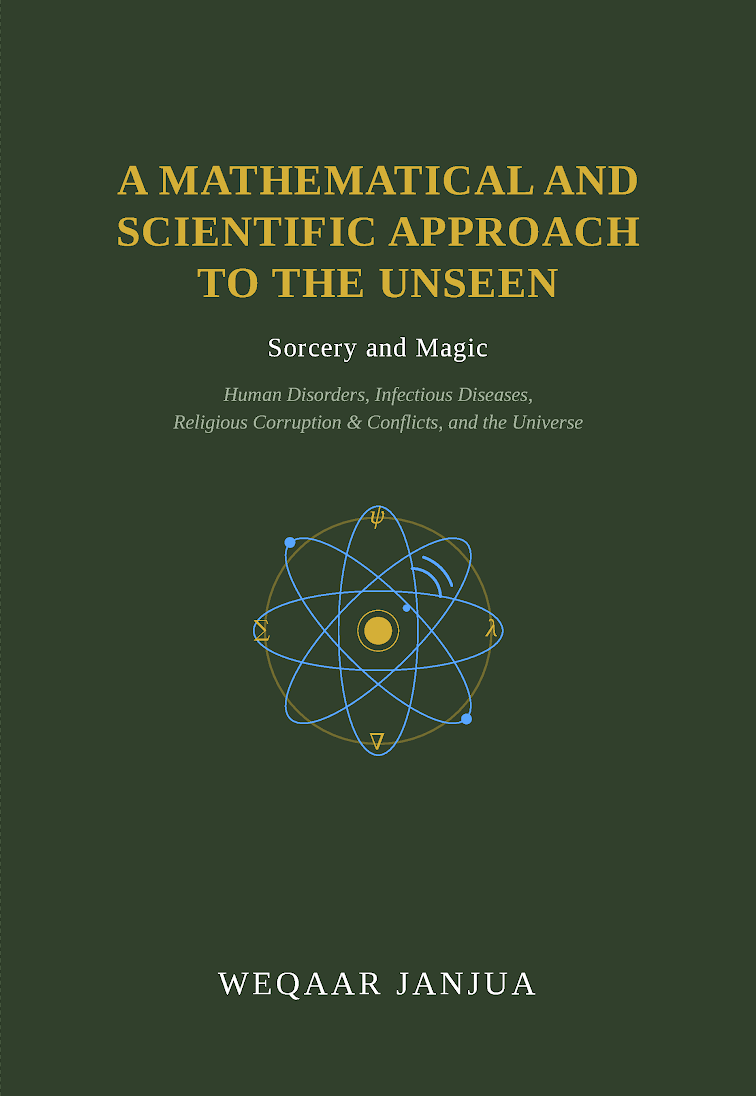
A Mathematical and Scientific Approach to the Unseen
Human Health and Suffering,
Religious Corruption and Conflict, and the Universe
The book examines sorcery, magic, human suffering, religious corruption, conflict, and the universe through the Quran, reliably transmitted Sunnah, mathematical reasoning, and the natural sciences.
First Edition · Available now on Lulu and Amazon
Click the cover to flip · Zoom to inspect closely
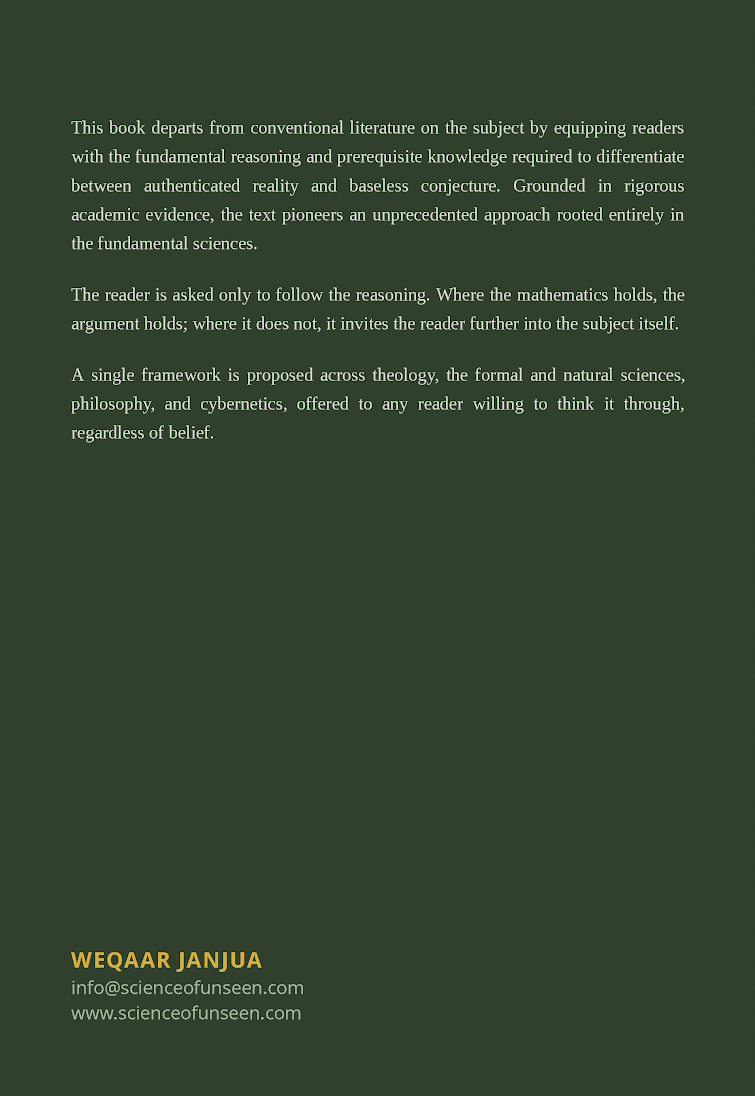
A Mathematical and Scientific Approach to the Unseen examines sorcery, magic, human suffering, religious corruption, conflict, and the universe through the Quran, reliably transmitted Sunnah, mathematical reasoning, and the natural sciences.
Author considers what Islamic sources teach about the unseen, what observation and research can establish, and where explanations remain uncertain. The book proceeds from the conviction that authentic revelation and sound scientific knowledge do not conflict, while distinguishing religious teachings from the author's own interpretations.
Topics include Al-Ghayb, sihr, jinn, reports of possession, illness and recovery, unwanted thoughts and religious anxiety, talismans, and protective practices. Discussions of religious authority, sectarian division, and conflict examine how beliefs are understood and used. Chapters on the physical universe address causation, cosmology, and the limits of human observation.
Mathematical explanations and equations are supported by plain-language context for readers without specialist training. They clarify reasoning and its assumptions rather than serve as scientific proof of supernatural causes. Reports of distress are examined without treating symptoms alone as confirmation of sihr or replacing necessary medical care with spiritual explanations.
Written for general readers as well as those with technical interests, this book connects Islamic teaching with careful examination of evidence and explanations. It is the first volume in the Series on the Unseen, Human Suffering, and Divine Protection Against Magic (Sihr) and Witchcraft.
Islamic teaching about Al-Ghayb, the Unseen, and a mathematical way to describe what people know at a given time. Examples distinguish what is not yet known from what human observation cannot establish.
Examples explain how actions affect what happens next, how conditions remain steady or become unstable, and why small differences can sometimes lead to different outcomes. These comparisons help readers follow the reasoning; they do not establish a physical process by which sihr causes harm.
The book examines illness, reports of experiences described as possession, and unwanted thoughts through religious teaching and published clinical research. It explains why symptoms require careful assessment rather than an immediate assumption of a spiritual cause.
How religious priorities can shift, why context matters when discussing rulings, and how communities can disagree. Mathematical comparisons help organise questions without assigning numerical ranks to people's faith.
A free booklet for readers who have not studied the mathematics, science, and philosophy the book draws on. Each part explains one tool from the beginning and works a small example three ways: with paper and a calculator, in GNU Octave, and in Python. Chapters that use these tools open with a short box that names the part of the companion to read.
Download the Reader’s Companion (PDF)Now published and available to buy on Lulu and Amazon. Choose a store below for available formats, pricing, and delivery options.
Order the paperback from Lulu.
Buy it now on LuluCheck Lulu for pricing and shipping to your country.
Choose the paperback or Kindle ebook.
Paperback on Amazon Kindle ebook on AmazonTo find the book on your country’s Amazon site, search using its Amazon Standard Identification Number (ASIN).
Paperback ASIN B0HLWJYWC4
Kindle ebook ASIN B0HLWSK23H
The Amazon hardcover is not yet published. Check each listing for pricing and availability in your country.
The work is meant to be read widely. Concessional pricing is offered for those in study and research, and periodic promotions are announced here.
Enrolled students can request a concessional price on the direct ebook. Include your institution and a student email or ID when you write in.
Libraries, departments, and reading groups can request bulk or institutional pricing for multiple copies, digital or print.
Time-limited Amazon price promotions and direct voucher codes are posted here when live. Ask to be notified of the next one.
This is the First Edition of an ongoing body of work, a series of independent research papers and further volumes. Buying the book already supports it. If you or your organisation would like to fund the research directly, sponsor a paper, or discuss a collaboration, please get in touch.
The simplest way to help. Every copy, on Amazon or direct, funds the next paper and the next volume.
Individuals, foundations, and institutions can contribute to the research programme or sponsor a specific paper.
Researchers and reviewers across mathematics, the sciences, and theology are welcome to reach out.
Questions about the book, direct purchase, discounts, or the research? Write below, or email info@scienceofunseen.com.
Scroll or pinch to zoom · drag to pan · double‑click to reset